
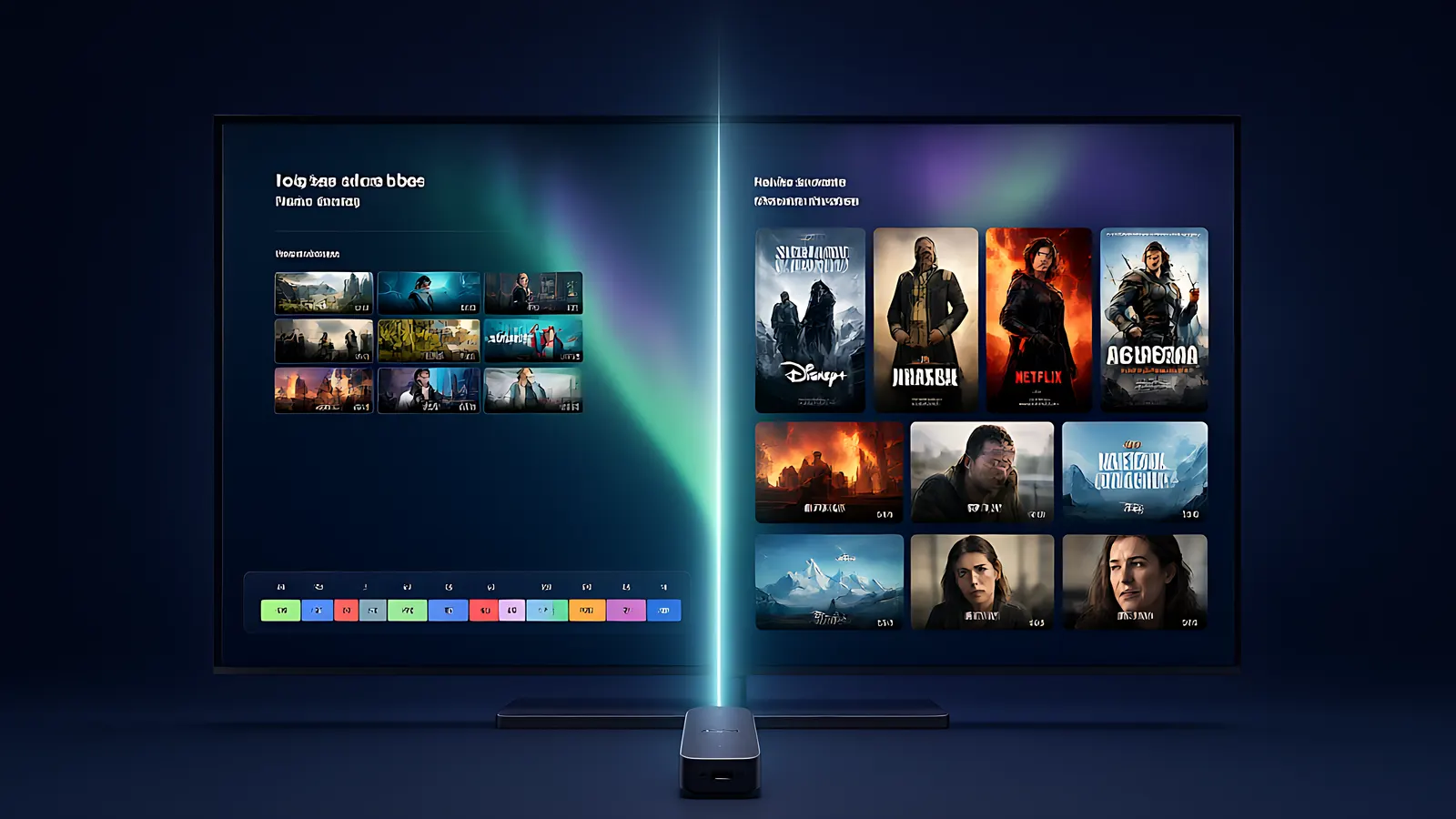
What Is OTT? The 2026 Explainer — OTT Platforms, Boxes, and How They Differ From IPTV
"What is OTT?" — the plain-English 2026 explainer: OTT platforms vs OTT boxes vs the brands behind the searches, and where IPTV actually sits in the picture.
Quick answer: OTT — over-the-top — is video that is delivered over the public internet instead of through a cable, satellite, or broadcast gateway. Netflix, Disney+, YouTube, and Apple TV+ are OTT platforms; the sticks and boxes you plug into a TV to run them are commonly called OTT boxes. The term is also used loosely for anything that streams over the internet, which is exactly why people end up comparing it to IPTV.
If you have ever searched "what is OTT" or "OTT meaning" while half-watching a movie on a stick and wondering how it got there, this guide is the version without the jargon. It covers what OTT actually is, what an OTT box does, why "OTT light" and "OTT tune" show up in searches, and where IPTV sits in the picture — because the two terms are used interchangeably in marketing and are not the same thing.
What OTT means
"Over-the-top" borrows its name from military radio protocol — messages sent "over the top" of formal channels without going through official routing. In video, the meaning is simpler: the provider does not need to own the pipes. It pushes content over your existing internet connection, directly to whatever device you are watching on. No cable operator, no satellite dish, no broadcast tower sitting between the content and your screen.
That distinction is the whole business model. A traditional pay-TV company must build or lease infrastructure — coaxial cable, satellite uplinks, set-top boxes it ships to your door. An OTT platform needs a CDN (content delivery network), an app, and a payment method. That is why new entrants can launch a global service in months, and why prices, ad tiers, and regional catalogs change so often. The Fox–Roku move is one example of the industry closing that gap between who owns the content and who owns the screen.
The four things people call "OTT"
Search results for "OTT" mix four different objects, and knowing which one you mean saves a lot of confusion:
- OTT platforms (services). Netflix, Disney+, Amazon Prime Video, Hulu, Apple TV+, YouTube. Subscription or ad-supported on-demand libraries, delivered over the internet. When someone asks about "OTT releases" — for example a film landing "on OTT" — they mean its first streaming availability, not a broadcast premiere.
- OTT boxes and sticks (hardware). A Chromecast, Fire TV Stick, Nvidia Shield, or any Android TV box that runs those platforms. "What is an OTT box?" usually means: what do I buy to watch OTT services on a regular TV?
- Specific brands and apps. Search snippets pull up "OTT Light" (a low-cost set-top device line) and "OTT Tune" (tuner-style hardware/apps) as if they were the category. They are products, not definitions — same way "Netflix" is a product and "OTT" is the category.
- OTT as a generic "internet video." In many markets, especially South Asia, "OTT" has become shorthand for any internet-delivered TV or movies, including IPTV. That loose usage is the source of most of the confusion this article exists to clear up.
OTT vs IPTV: what is actually different
Both deliver video over the internet. Both can reach the same living room. The difference is what is at the center of the model:
| OTT platforms | IPTV | |
|---|---|---|
| Core content | On-demand catalog (movies, series) | Live channel lineup, plus VOD and catch-up |
| Watching | Browse and press play | Channel zapping, EPG guide, multi-view |
| Live sports | Where licensed, often PPV-priced on top | Bundled into the channel lineup |
| Cost shape | Per-service subscriptions stacking up | One subscription covering a wide channel base |
| Device examples | Apps on any smart TV, stick, phone | Player apps (TiviMate, IPTV Smarters) fed by M3U/Xtream credentials |
Neither is "newer technology" than the other — they both ride the same CDNs, encoders, and adaptive-bitrate delivery. The practical comparison is about content shape and cost. The line-by-line cost math between a five-service streaming household and a single live-TV subscription shows where the gap is largest: live sports and international channels, which pure OTT services rarely carry together.
How OTT (and IPTV) actually reaches your screen
Underneath, both systems do the same three things: encode video into small segments, distribute those segments from servers close to you, and let the player swap quality on the fly as bandwidth changes. That last part — adaptive bitrate — is why a stream dips to 540p in a bad moment instead of freezing for a good one. It is also why most "my TV keeps buffering" problems are local-network problems, not service problems: congested Wi-Fi, a saturated router, or ISP throttling during peak hours will wreck any stream, OTT or IPTV. The buffering guide walks through finding out which of those you have, and the troubleshooting guide covers the account-to-device chain when something stops working at all.
When OTT is not enough
OTT is the right answer for catalog viewing: the latest films, binge series, and ad-free tiers. Where households usually hit a wall is the live, linear half of TV — 24-hour news loops, international channels, sports beyond what one or two platforms license, and the simple channel-surf habit that on-demand cannot replace. That is the half of television IPTV was built around, and it is why a 2026 setup more and more often pairs a couple of OTT apps for the library with a live channel lineup for everything else. The full picture, from credentials to devices, is in the complete IPTV guide.
NANO IPTV covers the live half: 25,000+ live channels, 140,000+ on-demand titles, EPG and catch-up included, on the devices you already own. If you came here from an "OTT vs IPTV" search and want the numbers behind choosing one — start with the cost comparison, then try the plans. Setup takes minutes once you have your credentials, and the free trial gives you a day to test the line-up on your own hardware before committing.
The NANO IPTV engineering team collectively authors guides on EPG, VOD, catch-up, and streaming infrastructure. Based across Stockholm, Lisbon, and Almaty. We write the documentation we wish we had when we started building this platform.