
IPTV Glossary — Every Term Explained
M3U, Xtream Codes, EPG, VOD, catch-up, timeshift, HLS — every IPTV term you will encounter, explained in one place. Bookmark this page.
IPTV services throw a lot of acronyms at you. M3U, Xtream Codes, EPG, HLS — and none of them come with instructions. This glossary exists so you never have to Google what "timeshift" means at midnight when you just want to watch a football match. Every term below is explained in plain English, in alphabetical order.
Adaptive Bitrate (ABR)
The technology that keeps your stream from choking when your Wi-Fi dips. ABR watches your connection speed in real time and swaps to a lower-resolution version of the stream before you notice the drop. When your speed recovers, it bumps quality back up automatically.
Buffering
That spinning circle when your stream pauses to load more video data. It happens when your internet cannot feed the player fast enough. WiFi congestion, too many devices on the network, or simply not enough bandwidth are the usual culprits.
Catch-up
The ability to rewind a live broadcast and watch something that already aired — typically within the last 3 to 7 days. Not every channel supports it, and the exact window depends on the provider. When available, you will see a catch-up icon or a rewind option in your player.
Connection Limit
The number of simultaneous streams your account allows. If your plan has one connection, you can watch on one device at a time. Trying to stream on a second device at the same time will kick the first one off or block it entirely.
EPG (Electronic Program Guide)
The on-screen TV guide that shows what is playing right now, what comes next, and what is on for the next several days. It is the same grid you see on cable TV, just pulled over the internet instead.
HLS (HTTP Live Streaming)
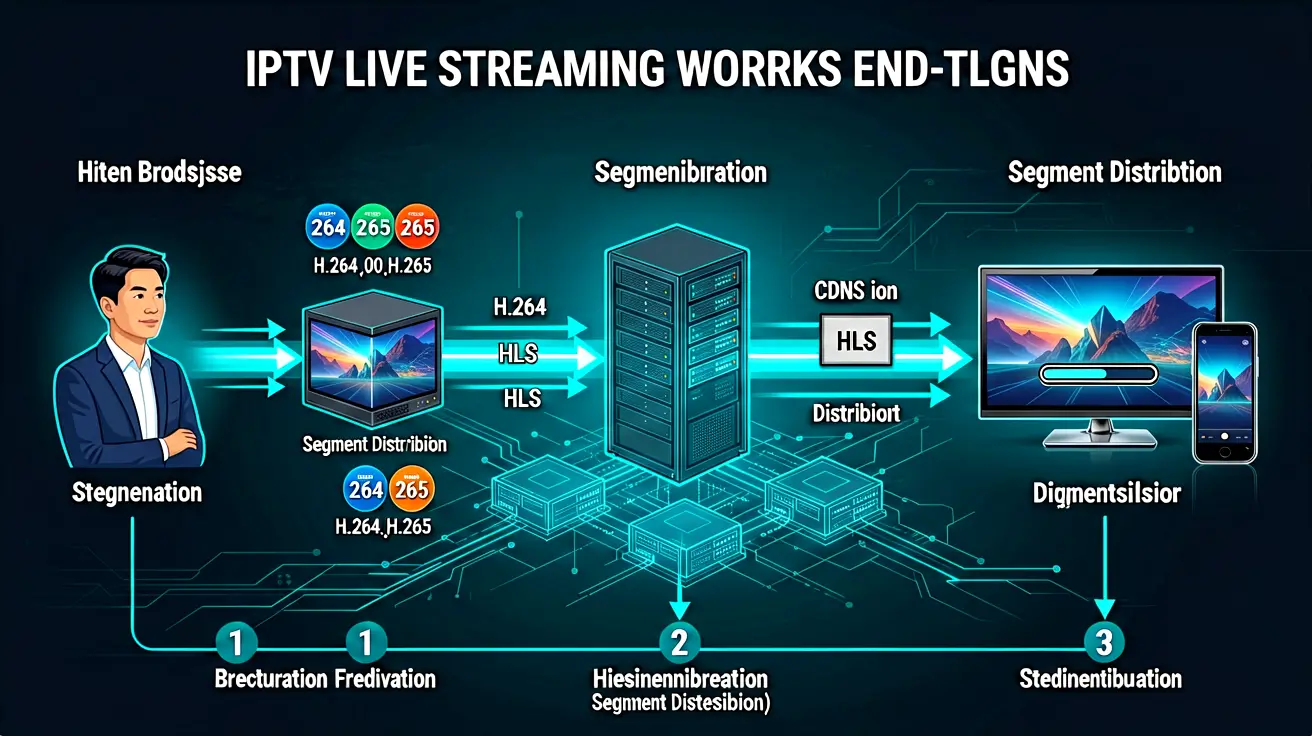
The most widely used streaming protocol. HLS chops video into tiny HTTP segments and sends them to your player in sequence. It works on virtually every device and connection type, which is why most IPTV providers default to it.
IPTV
Short for Internet Protocol Television. Instead of receiving TV through a satellite dish or cable box, the signal arrives over your internet connection. That means you can watch on a phone, tablet, laptop, smart TV, or a set-top box — anywhere you have a decent connection.
IPTV Player
The app that actually displays channels and content on your device. Popular options include TiviMate, IPTV Smarters, VLC, and OTT Navigator. The player does not provide content — it just plays the streams your IPTV service gives you.
M3U
A playlist file format used in IPTV. Your provider gives you an M3U URL, you paste it into a player, and your entire channel list loads. It is a simple, universal format that works with nearly every IPTV player on every platform.
MPEG-DASH
An open streaming protocol similar to HLS, developed by the same standards bodies that define video compression. It is technically more efficient than HLS but less universally supported. You will see it less often, but some players handle it well.
Playlist
A list of channels and streams your IPTV provider supplies. In practice, this is an M3U URL (or an Xtream Codes login) that your player uses to build your full channel guide. Nothing plays without one.
Timeshift
The ability to pause and rewind live TV within a local buffer your player stores — usually only a few minutes. Unlike catch-up, timeshift only works on the current broadcast, and it clears when you stop watching or switch channels.
VOD (Video on Demand)
A library of movies and TV series you can start watching at any time, independent of live broadcast schedules. Think of it as the Netflix-style section inside your IPTV service.
Xtream Codes
A login-based API that replaces M3U URLs with a username, password, and server address. Players that support Xtream Codes can pull your channel list, EPG, and VOD library automatically after a single login. It is cleaner and more reliable than M3U, and it is the format NANO IPTV uses.
XMLTV
The file format that carries EPG data. Your player downloads an XMLTV file — once a day, usually overnight — and uses it to populate the on-screen program guide with show titles, descriptions, and time slots.
Sasha handles the server fleet and network topology. Background in telecom and ISP operations — if something needs to get packets from A to B with sub-millisecond jitter, she is the person who makes it happen. Writes about player configuration, latency, and protocol internals.